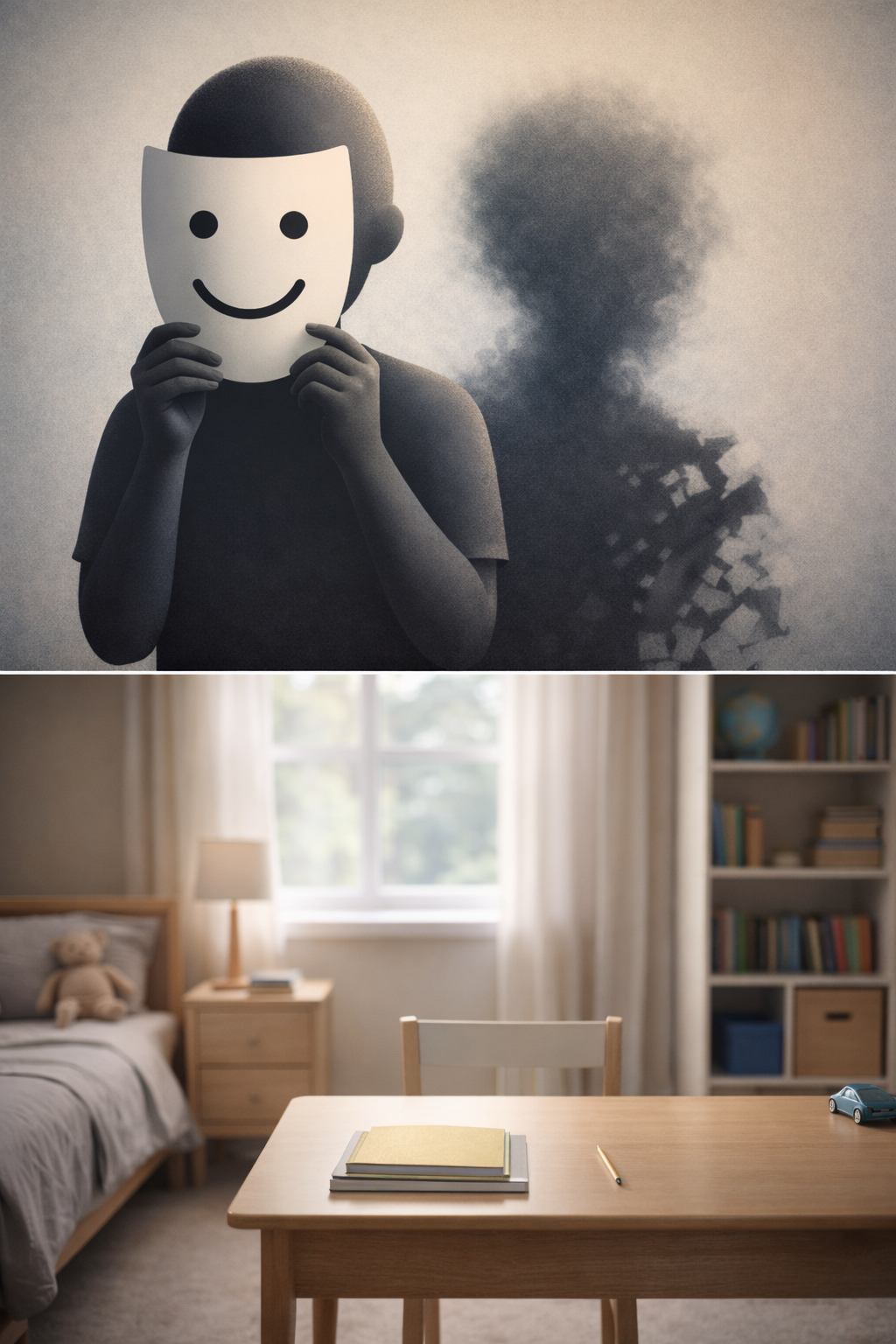
Modern child welfare and family court systems rely heavily on adult presentation. Calm demeanor, articulate speech, and surface compliance are often interpreted as indicators of stability and safety. However, trauma psychology consistently demonstrates that external composure is not a reliable measure of internal regulation or emotional safety.
Children are affected not by how adults perform in controlled environments, but by how those adults respond during stress, frustration, and loss of control. Presentation captures moments. Trauma forms in patterns.
According to Gabor Maté, many individuals learn early to suppress emotion as a survival strategy. This emotional suppression can appear as calmness, self-control, or maturity, while masking unresolved trauma that surfaces in private or high-stress situations.
Systems that prioritize presentation over impact risk confusing emotional containment with emotional health.
Why Presentation Is a Poor Proxy for Safety
Trauma-informed research shows that some of the most harmful relational dynamics occur in environments that appear orderly from the outside. Emotional harm often leaves no visible marks and rarely presents itself during formal observation.
Caregivers who are emotionally avoidant, dissociated, or rigidly controlled may:
- maintain composure in professional settings
- communicate calmly with authority figures
- follow rules precisely
- suppress visible emotional reactions
None of these behaviors guarantee emotional safety for a child.
In contrast, protective caregivers who are distressed, outspoken, or emotionally reactive may be flagged as unstable, despite responding to genuine fear or concern for a child’s wellbeing.
This creates a structural bias: those who perform calmness are trusted; those who express distress are scrutinized.
Impact on Children
When systems rely on presentation, children are placed in an impossible position.
Children harmed by emotionally controlled caregivers often learn:
- that speaking up will not be believed
- that fear must be hidden
- that safety depends on silence
- that adults value order over truth
Over time, this can result in:
- emotional numbing or dissociation
- hypervigilance around authority
- difficulty trusting caregivers
- increased risk of anxiety, depression, and later substance use
Gabor Maté has repeatedly emphasized that trauma is not defined solely by what happens to a person, but by what happens inside them when their emotional reality is not acknowledged or protected.
A child who is not believed learns to adapt by disappearing.
Why Distressed Parents Are Often Misjudged
Protective parents navigating fear, loss, or perceived danger frequently show visible emotional responses. Trauma science recognizes these reactions as stress responses, not character defects.
However, systems often misinterpret:
- urgency as manipulation
- emotional expression as instability
- persistence as interference
This mislabeling can lead to reduced trust in the very caregivers who are most attuned to a child’s distress.
The result is an inversion of safety: the calm adult is trusted, the distressed adult is doubted, and the child’s symptoms are minimized.
Alternatives: Measuring What Actually Matters
1. Longitudinal Assessment Over Snapshot Observation
Safety should be evaluated across time and contexts, not single interactions. Patterns of behavior, not momentary composure, reveal emotional risk.
2. Weighting Child Symptoms Over Adult Demeanor
Nightmares, anxiety, regression, and fear-based compliance are stronger indicators of harm than an adult’s ability to remain calm during interviews.
3. Trauma-Informed Evaluator Training
Professionals must be trained to recognize:
- emotional suppression
- dissociation
- performative compliance
- charm as a defense mechanism
These are trauma adaptations, not evidence of health.
4. Differentiating Distress From Danger
Emotional expression in caregivers should be evaluated in context. Distress does not equal instability. Silence does not equal safety.
Core Truth
Calm is not the same as regulated.
Controlled is not the same as safe.
And children should never be expected to suffer quietly so adults can look composed.
Systems that value presentation over impact risk protecting appearances rather than children.
Site References / Sources
Primary Trauma & Psychology Sources
- Gabor Maté
- In the Realm of Hungry Ghosts
- The Myth of Normal
- Lectures on trauma, emotional suppression, and addiction as adaptation
- Bessel van der Kolk
- The Body Keeps the Score
- Research on trauma, dissociation, and nervous system regulation
- Stephen Porges
- Polyvagal Theory and nervous system states
- Research on threat responses, shutdown, and social engagement
Supporting Concepts
- Attachment theory
- Fear-based compliance
- Dissociation as adaptation
- Emotional regulation vs emotional suppression
- Longitudinal vs snapshot assessment


 Dark Tales of Understanding