Fear-Based Compliance Is Not Safety


Fear-based compliance occurs when children obey not because they understand boundaries, but because their nervous system has learned that resistance leads to emotional or physical threat. This kind of “good behavior” is often praised by adults and institutions because it is quiet, predictable, and easy to manage.


Trauma psychology shows that fear suppresses outward behavior while intensifying internal stress. According to Gabor Maté, children adapt to unsafe environments by disconnecting from their authentic emotional responses. Obedience becomes a survival strategy, not a sign of wellbeing.


When compliance is driven by fear, learning does not occur. The brain shifts out of the prefrontal cortex, where reasoning and integration happen, and into survival mode. In that state, children memorize rules without understanding them and suppress emotions instead of regulating them.


Impact on Children
Fear-based compliance produces children who appear functional while carrying invisible harm. Common long-term effects include:
Chronic anxiety and hypervigilance
Nightmares and sleep disturbances
Excessive people-pleasing and fear of authority
Emotional shutdown or dissociation
Difficulty identifying or expressing feelings
Increased risk of depression and substance use in adolescence or adulthood.


These children often receive praise for being “easy,” “mature,” or “well-behaved.” In reality, they are over-adapted. Their nervous systems have learned that safety comes from disappearing.
As Gabor Maté explains, addiction and self-destructive behaviors later in life frequently trace back to early environments where authentic emotion was unsafe to express. Fear-based compliance teaches children that their feelings are liabilities rather than signals.


Why Systems Misread Fear as Safety
Institutions often equate compliance with stability because it reduces visible disruption. A quiet child is assumed to be coping well. A calm household is assumed to be healthy.
This creates a dangerous blind spot:
Children who freeze are overlooked
Distress that does not disrupt adults is minimized
Emotional harm is missed because it lacks spectacle


Children rarely disclose fear directly when the source is a caregiver. Instead, fear shows up somatically through stomach aches, headaches, sleep problems, regression, or sudden behavioral changes. When systems ignore these signs, fear becomes invisible.


Alternatives: What Safety Actually Looks Like


1. Measuring Regulation, Not Obedience
True safety is reflected in a child’s ability to:
express disagreement without fear
recover emotionally after conflict
ask for help
show age-appropriate emotional range
Evaluations should assess emotional flexibility and recovery, not silence.


2. Child-Centered Emotional Assessments
Children should be evaluated by trauma-trained clinicians who understand how fear manifests without words. Emotional safety cannot be assessed through yes-or-no questions or surface behavior alone.


3. Caregiver Accountability for Emotional Climate
Adults must be evaluated not only on rule enforcement, but on:
tone
predictability
repair after conflict
willingness to tolerate a child’s emotions
Fear decreases when children know mistakes will not lead to emotional retaliation.


Core Truth
A child who is safe will sometimes cry, argue, resist, and express anger.
A child who is afraid will comply.
Silence is not peace.
Compliance is not consent.
And fear should never be mistaken for safety.


4. Repair as a Requirement, Not a Suggestion
When discipline causes distress, repair must follow. Repair restores safety and teaches accountability. Without it, fear accumulates.


5. Oversight That Values Child Voice
Children must be allowed to express discomfort without being labeled disloyal, coached, or manipulative. Safety increases when children learn that truth does not cost connection.

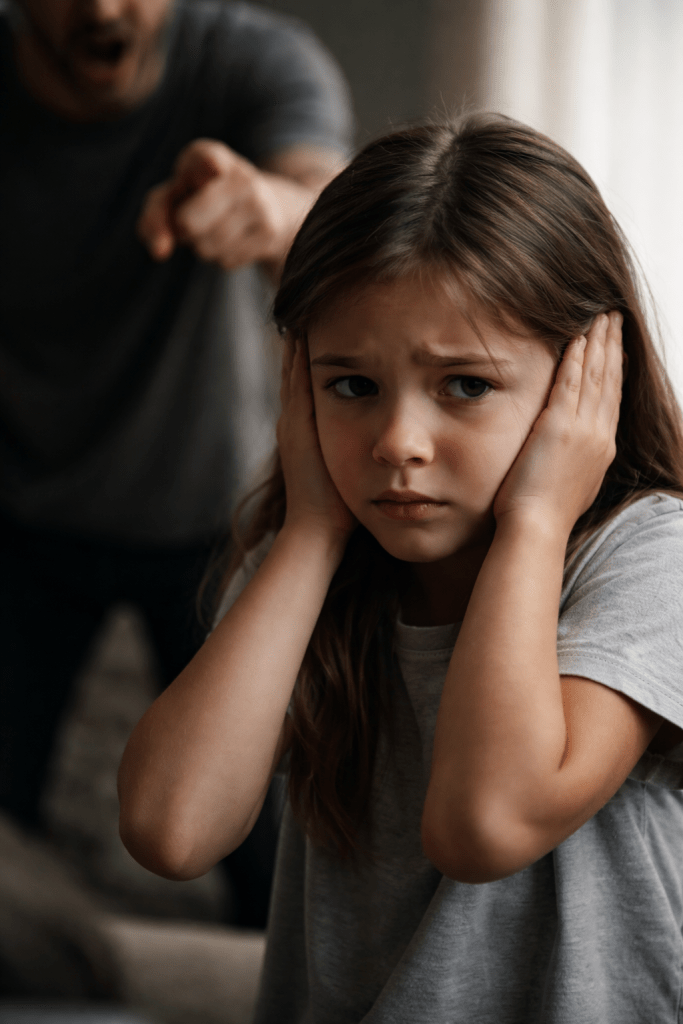
When Discipline Is Driven by Anger, It Becomes Abuse


Discipline is meant to teach regulation, responsibility, and repair. When it is driven by uncontrolled anger, frustration, or emotional overflow, it stops being corrective and becomes harmful. Trauma research consistently shows that children do not learn emotional regulation from dysregulated adults.

According to Gabor Maté, children absorb the emotional state of caregivers more than the words they hear. When a caregiver disciplines while emotionally flooded, the child’s nervous system prioritizes survival over learning.


Impact on Children


Anger-based discipline produces:


• Hypervigilance
•Nightmares and sleep disturbances
•Fear-based compliance mistaken for “good behavior”
•Emotional shutdown or explosive behavior later in life
•Children raised under unpredictable emotional responses often learn that safety depends on reading moods, not understanding boundaries.

What Can Replace Anger-Driven “Discipline”


1. Mandatory Emotional Regulation Assessment for Caregivers


What it is:
Before a caregiver’s disciplinary methods are evaluated, their capacity to self-regulate under stress should be assessed by a trauma-informed professional.
This is not a character test. It’s a nervous system evaluation.


Why it matters:
Discipline delivered while emotionally flooded cannot be corrective. Research consistently shows that dysregulated adults transmit stress biologically through tone, posture, facial expression, and unpredictability.
Gabor Maté emphasizes that children internalize the emotional state of caregivers more deeply than verbal instruction. When adults lack regulation, children learn fear, not values.


How it could be implemented:
Standardized screening for emotional reactivity, impulse control, and stress tolerance
Required before granting unsupervised disciplinary authority in high-conflict cases
Used to determine supports, not punishment


Impact:
This shifts focus from “did the parent mean harm” to “does the parent have the capacity to discipline safely.”


2. Distinguishing Discipline From Emotional Discharge


What it is:
Systems must explicitly separate discipline from emotional discharge.


Discipline:
is planned
proportional
consistent
followed by repair


Emotional discharge:
occurs during frustration or loss of control
is unpredictable
escalates
centers the adult’s emotions


Why it matters:
Many abusive dynamics are misclassified as “strict parenting” because intent is emphasized over impact.
Children cannot differentiate between “I’m being corrected” and “I’m being emotionally overwhelmed by an adult.” Their nervous system only registers threat.


How it could be implemented:
Evaluators trained to ask when discipline occurs, not just how
Required documentation of post-discipline repair
Clear criteria defining when discipline crosses into emotional harm


Impact:
This removes ambiguity that allows anger to masquerade as authority.


3. Trauma-Informed Parenting Education Focused on Co-Regulation


What it is:
Parenting education that teaches co-regulation rather than control.
Co-regulation means:
the adult regulates themselves first
the child borrows calm from the adult’s nervous system
boundaries are enforced without fear


Why it matters:
Children develop self-regulation through repeated experiences of being calmed, not commanded.
Gabor Maté notes that emotional dysregulation in adulthood often originates from childhood environments where emotions were punished instead of guided.


How it could be implemented:
Mandatory trauma-informed parenting courses when emotional harm is suspected
Skills-based training, not compliance-based classes
Ongoing support rather than one-time completion


Impact:
This reduces harm without removing children or criminalizing parents who are willing to change.


4. Child Symptom Patterns as Primary Evidence


What it is:
Shift evaluations from adult narratives to child symptom patterns.


Symptoms include:
nightmares
regression
anxiety
hypervigilance
emotional shutdown
fear of disclosure


Why it matters:
Children often cannot articulate abuse directly, especially when the source is a caregiver. Their bodies speak instead.
Behavioral silence is often misread as stability. Trauma science shows it is frequently a sign of learned helplessness.


How it could be implemented:
Longitudinal tracking of child emotional health
Greater weight given to patterns over time
Clinician-led interpretation, not investigator assumption


Impact:
This centers child wellbeing rather than adult performance.


5. Built-In Repair and Accountability Requirements


What it is:
Any disciplinary intervention that causes emotional distress must be followed by documented repair.
Repair includes:
acknowledgment of harm
emotional reassurance
restoration of safety
validation of the child’s feelings


Why it matters:
Trauma is not caused solely by harm, but by harm without repair.
Children can tolerate mistakes from caregivers when those mistakes are acknowledged and repaired. They are damaged when harm is denied or justified.


How it could be implemented:
Repair plans as part of parenting oversight
Evaluation of accountability, not just rule-following
Consequences for refusal to engage in repair


Impact:
This replaces power-based parenting with responsibility-based parenting.


6. Neutral, Trauma-Trained Oversight Instead of Performance-Based Monitoring


What it is:
Oversight conducted by trauma-trained professionals who observe real-world interactions, not staged compliance.


Why it matters:
Anger-driven discipline rarely appears during formal observation. It emerges during stress, fatigue, or frustration.
Systems that rely on brief observations reward parents who can perform calmness temporarily.
How it could be implemented:
Multiple observation contexts
Input from therapists, teachers, and visitation supervisors
Reduced reliance on single-point assessments


Impact:
This protects children from harm that hides behind composure.


Why These Alternatives Matter


These approaches:
•protect children without default removal
•reduce long-term trauma and addiction risk
•hold caregivers accountable without criminalization
•remove incentives for emotional suppression and performance

Most importantly, they acknowledge a core truth systems resist:
•Children do not need perfect parents.
•They need regulated ones.

Destination: Week 1

Retreat to your childhood. Make a list of all the things you thought you wanted to be when you were younger and why. List everything down, even if it was a circus clown. Think about the things in life that shifted your decision to chase that path and reflect on what path you settled for. Do you wish to change the path your on?

Enlightenment Begins Within

Struggling with Abandonment

Constantly living in fear of what can happen, will ruin what is happening. I know this too well. Because I’m doing it.

Abandonment Issues, heard the term? It typically happens when a caregiver or parent doesn’t give the child enough attention or attentive behaviors the child needs. Traumatized by life, or the things people have done to them.. tricky thing is, over time the child turns to an adult, having learned these patterns of how their caregivers “lack of” has always been. While in romantic or platonic relationships, when the same patterns arise they automatically recognize, the overwhelming anxiety and fear sets in. These people may also exhibit behaviors that push people to leave so they’re never surprised by the loss.

Many who suffer with this issue often find themselves fearing real intimacy, cycling through relationships in order to avoid heartache. When they find someone, the sometimes become irrational, self sabotaging themselves to leave. Many find themselves staying in unhealthy relationships simply because they don’t want to be alone. Last but not least, WE NEED CONSTANT REASSURANCE.

Everyone has or will leave. That’s how it’s always been. Unfortunately, there’s no cure for this. It’s a form of overwhelming anxiety. You either learn who to hold on to and who to let go. I wish it was as easy as just trusting your words, but when actions follow.. we learn, we “wall up” push you to leave, or we leave. It’s not simple or easy for anyone involved. It takes Trust, Communication, and Actions.

“I give anyone a chance, but once you come at me left, then my perception of you has changed for life. Because You didn’t have to do me like you did. And you know I’m 100. But you did that.” -Kevin Gates

Isolation

How do we stop blaming others for our unhappiness when they never caused the pain we silently suffer from? Self Sabotage at its finest hour!

The smallest thing can set off a full episode. The first sign of sketchiness, doubt or even simply recognized patterns, we step right into flight or fight mode. What steps do you take to overcome this anxiety? Triggers will be everywhere, and what defines you is how you deal with it. I usually call a friend, but if that’s not possible stepping outside to breath and think more positively can help.

Okay. So say you have already surpassed the anxiety and a full fledged panic attack is on the rise, what do you do then? If you want to avoid taking the pain out on those around you, I suggest isolation for a few moments is still always a positive way to deal accordingly.

Long term pointers- Surrounding yourself with people who understand, is always a good way towards healing. I know it sounds weird, how can they help? Just a support system in place is the biggest step, helping aim you down your path to inward self healing. Guidance, advice, or just someone to vent to. All very serious contributions.

Isolation for a few moments can be very soothing to your mind. No conflicting opinions. Just silence to breath. Say a mantra, sing a song, or Count to 10! It’s silly, but it can help. If it gets to the point, these don’t help.. call someone to help talk you down. Are you in a position, to ask for help? Don’t be scared. I know people just don’t get it, but I promise there are a few who do.

If you have an open communication with your loved ones.. I suggest always telling them how you feel. Maybe not all of it at once, but bits an pieces along the way so they can learn that this happens. And, please apologize before hand when explaining that although they haven’t done things necessarily to you, triggers can’t be avoided but understanding for future endeavors can be very important. I know this road isn’t easy, but the more you learn about it, Talk about it and put those teachings into action, the easier the process of changed behavior can be for you and those around you as well.

#LetsTalkAboutIt #TiBbyHonest! 05/14/3021

Topics of Duscussion

  • Anxiety
  • Feeling yourself falling
  • Having mad Love and Support is crucial!
  • Understanding

Following the root and branches if what the underline cause of your “everyday” anxiety.

Social Theory referred to ideas, arguments, hypothesis, thought-experiements and explanatory speculations about how and why humans societies – or elements or structures of such societies- come to be form change and delvelope over time or disappear.

Www.oxfordbibligraphies.com July 27th 2011

Social contructionist theory

  1. Rational Choice
  2. Structurtional Functionalism
  3. Social Action

Theories by: Spencer and Durkheim, Weber and Pareto

All analytical frameworks, paradigms, used to study and interpret social phenomenon.

Social Theory 05/14/3021

Topics of Duscussion

  • Anxiety
  • Feeling yourself falling
  • Having mad Love and Support is crucial!
  • Understanding

Following the root and branches if what the underline cause of your “everyday” anxiety.

Social Theory referred to ideas, arguments, hypothesis, thought-experiements and explanatory speculations about how and why humans societies – or elements or structures of such societies- come to be form change and delvelope over time or disappear.

Www.oxfordbibligraphies.com July 27th 2011

Social contructionist theory

  1. Rational Choice
  2. Structurtional Functionalism
  3. Social Action

Theories by: Spencer and Durkheim, Weber and Pareto

All analytical frameworks, paradigms, used to study and interpret social phenomenon.

#LetsTalkAboutIt 05/13/2021

Topics of Discussion

  • Addiction
  • Insomnia
  • Triggers
  • Medications
  • Chemical imbalances
  1. Small Goals
  2. Staying Focused

Source: http://www.healthline.com/

Continue reading