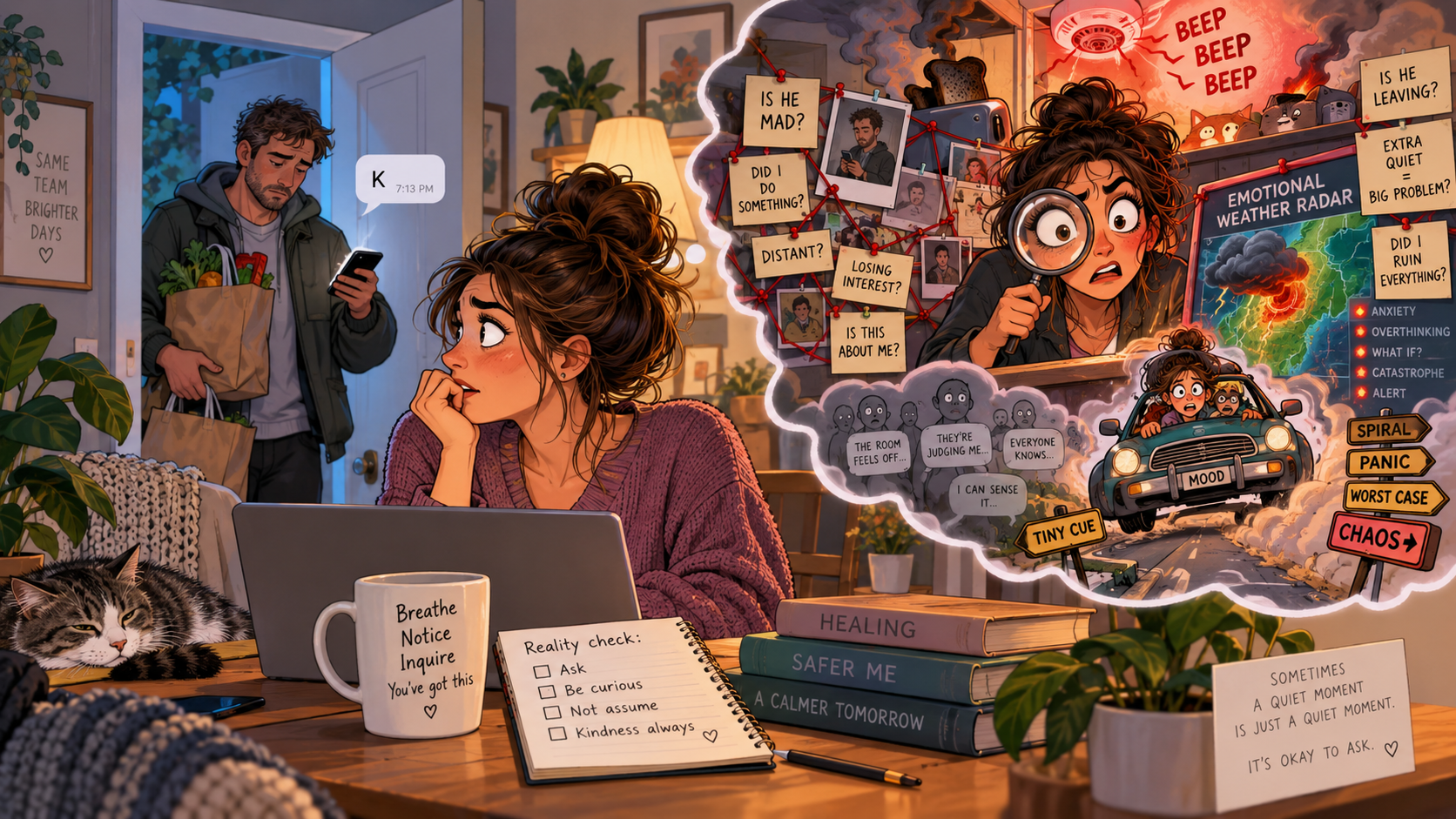
Some children grew up asking their parents what kind of day they had.
Other children knew before the parent took their shoes off.
The front door closed three decibels louder than normal.
Keys landed on the counter instead of the hook.
Mom’s jaw was tight.
Dad sighed before answering a question.
The refrigerator door got shut with unnecessary enthusiasm.
Nobody announced that the mood in the house had changed, but everybody knew.
And somewhere in the room, one kid quietly adjusted.
Talk less.
Don’t ask for anything.
Keep your brother from making noise.
Clean something.
Disappear.
Be funny.
Be useful.
Figure out whether tonight is going to be normal, uncomfortable, or one of those nights.
Nobody necessarily taught that child how to do this. There was no family meeting titled “Advanced Emotional Surveillance Techniques for Minors.”
The child simply learned.
When the emotional climate of a home is unpredictable, paying extremely close attention to other people can become useful. Research on childhood maltreatment suggests that some children become unusually sensitive to emotional threat cues. Abused children, for example, have been found to recognize anger with less perceptual information than other children, and some maltreated children identify fearful expressions faster. (PubMed Central (PMC))
That makes perfect sense.
If someone else’s mood determines whether dinner is peaceful or terrifying, their facial expression isn’t casual information.
It’s the weather report.
And you live outside.
The Mood Drove the Family Car
In some homes, the parent isn’t just another passenger in the emotional vehicle.
Their mood is driving.
Everybody else’s nervous system is buckled into the back seat.
If Mom is happy, everybody can breathe.
If Dad is irritated, the kids become quieter.
If a parent is unpredictable, everyone starts watching.
How hard did they close the door?
What tone did they use?
How quickly are they walking?
Did they answer normally?
Why haven’t they answered?
Was that sigh about work?
Was that sigh about me?
Should I ask?
Definitely don’t ask.
Actually, maybe asking will make it worse.
Maybe not asking will make it worse.
Fantastic.
Childhood has apparently become bomb disposal.
Research increasingly supports the importance of unpredictability itself. Unpredictable parental and household experiences have been associated with later emotional and mental-health difficulties, even beyond traditional measures of adverse childhood experiences. (PubMed Central (PMC))
A nervous system living in that environment has a perfectly reasonable assignment:
Predict what happens next.
The problem is that children grow up.
The assignment sometimes doesn’t.
Hypervigilance Becomes a Language Nobody Talks About
Eventually the behavior becomes so automatic that we don’t even call it hypervigilance.
We call it:
“I can read people.”
“I know when something is off.”
“I felt their energy change.”
“I know that look.”
“Something about their tone wasn’t right.”
And sometimes?
We’re absolutely correct.
That part shouldn’t be dismissed.
Research suggests childhood maltreatment can produce heightened sensitivity to certain threat-related emotional information. Some people really do notice subtle changes other people miss. (PubMed)
You noticed the smile tighten.
You heard the hesitation before the answer.
You recognized that someone’s voice changed when a particular subject came up.
You noticed they suddenly stopped making eye contact.
Your nervous system might be picking up legitimate information.
But here is the distinction that trauma rarely teaches us:
Noticing a cue and correctly explaining the cue are two completely different abilities.
You may be 100% correct that someone’s behavior changed.
That does not make you 100% correct about why.
That is where things get messy.
The Brain Hates an Unfinished Story
Imagine you’re talking to someone.
Everything is normal.
Then their responses get shorter.
They stop smiling.
They look at their phone.
Hypervigilance notices:
Something changed.
Excellent.
That may be accurate.
Then the brain begins submitting its screenplay:
They’re irritated.
They’re irritated with me.
I said something wrong.
They’re pulling away.
They’re hiding something.
They’ve probably been irritated for three weeks.
Actually, this explains Tuesday.
And Thursday.
And that weird “okay” text from February.
Congratulations.
We have gone from one facial expression to a six-part Netflix documentary.
The nervous system detected data.
The mind supplied the explanation.
And those aren’t the same thing.
Research illustrates exactly why this distinction matters. Childhood adversity has been linked with difficulty distinguishing threat from safety and with greater tendencies to interpret ambiguous or neutral facial information negatively. Some maltreated children, for example, have been more likely to label ambiguous expressions as angry. (PubMed)
So hypervigilance isn’t necessarily imaginary.
It may simply be calibrated toward avoiding missed threats, even at the expense of creating more false alarms.
And from a survival standpoint, that math makes sense.
If you’re a child living around actual danger, incorrectly assuming Dad is angry when he isn’t might mean hiding in your room unnecessarily.
Failing to notice when he really is angry might have much worse consequences.
The developing brain learns which mistake is safer.
Better ten false alarms than one missed explosion.
Useful childhood strategy.
Complicated adult relationship strategy.
So How Accurate Is Hypervigilance?
Here’s where we should resist the internet’s beloved tradition of inventing a percentage and putting it over a picture of a brain.
Science does not currently give us one meaningful number for how often a hypervigilant person’s intuition is correct.
There is too much variation between people, trauma histories, situations, emotional cues, and research methods.
More importantly, studies show a mixed picture.
Some trauma-exposed people identify certain negative emotions more quickly or with less information. Other research finds biases, misidentification, poorer threat-versus-safety discrimination, or difficulties predicting ordinary events. A systematic review of eye-tracking research in PTSD even found that evidence for a simple, across-the-board “superior threat detector” model is relatively weak. (PubMed Central (PMC))
One study of adults with PTSD found greater symptom severity was associated with more difficulty accurately predicting what happened next even during neutral everyday activities. (PubMed Central (PMC))
So the fairest interpretation is this:
Hypervigilance may improve sensitivity to particular cues without guaranteeing accuracy about what those cues mean.
Think smoke detector.
A highly sensitive smoke detector might detect smoke faster.
That’s useful.
But if it also starts screaming every time somebody makes toast, sensitivity has stopped being the same thing as accuracy.
When Hypervigilance Doesn’t Serve Us
The Short Text
You send:
“Are we still meeting tomorrow?”
They answer:
“Yep.”
Your nervous system:
They normally say “Yes lol.”
Something is wrong.
Your brain:
They’re pissed.
They’re distancing themselves.
I knew something changed.
Reality:
They’re standing in line at King Soopers holding laundry detergent and a rotisserie chicken.
The shortened response was real.
The international incident was fictional.
The Quiet Partner
Your partner gets home and seems unusually quiet.
You notice immediately.
That observation may be excellent.
Then you ask:
“What’s wrong?”
“Nothing.”
Now your nervous system starts stretching.
Nothing means something.
Something means me.
Me means relationship problem.
Relationship problem means abandonment.
We have now taken one quiet Tuesday and converted it into divorce proceedings.
Meanwhile, your partner has a headache.
The Boss’s Face
Your boss walks by looking irritated.
Hypervigilance clocks it instantly.
She’s mad.
Probably about your work.
Probably the thing you submitted yesterday.
You’re getting written up.
Maybe fired.
Better start looking for another job.
She just got an email saying the copier contract increased by $4,000.
You correctly identified irritation.
You incorrectly appointed yourself the cause.
This distinction matters enormously.
Hypervigilance Often Gets the Observation Right Before It Gets the Story Wrong
This may be one of the most useful ways to work with it.
Instead of telling yourself:
I’m imagining everything.
Try:
I may have noticed something accurately. I don’t yet know what it means.
That respects the nervous system without putting it in charge of criminal prosecution.
There is a difference between:
“You seem quieter than usual.”
and
“You’re obviously mad at me.”
One is an observation.
The other is a conclusion.
Between those two sentences lives an enormous amount of emotional freedom.
Inquire, Don’t Assume
Hypervigilance doesn’t need to be destroyed.
It needs a new job description.
Old job:
Detect threat and immediately determine the explanation.
New job:
Detect change and gather more information.
That can sound like:
“You seem quieter than you were earlier. Everything okay?”
“I noticed your tone changed when we started talking about that. Did something bother you?”
“I might be reading this wrong, but you seem uncomfortable. Am I picking up on something?”
“You seem frustrated. Is that about this conversation, or is something else going on?”
“I noticed you pulled back a little. My brain is trying to fill in the blanks, so I’d rather ask.”
This is where hypervigilance can become surprisingly useful.
Because someone who spent years noticing micro-changes in human behavior may have developed tremendous observational skills.
The goal isn’t necessarily to stop noticing.
The goal is to stop treating every observation like a verdict.
Turn Surveillance Into Curiosity
There is something deeply unfair about telling trauma survivors to simply “stop overthinking.”
The brain learned these behaviors because, somewhere along the way, noticing mattered.
Children adapt to the environments they’re raised in.
Research on maltreatment suggests that perceptual systems can essentially become tuned toward emotionally important information, particularly threat. (PubMed Central (PMC))
The adaptation wasn’t stupid.
It may have been brilliant.
But survival skills are context-dependent.
A machete is useful in a jungle.
Less useful during couples therapy.
The adult task isn’t:
Stop trusting yourself.
It’s:
Separate what you observed from what you inferred.
Try breaking the experience into three parts.
What did I actually observe?
His answers became shorter.
What is my brain telling me it means?
He’s angry with me.
What else could explain it?
He’s tired.
He’s distracted.
He’s worried about something else.
He’s irritated but not with me.
He’s overwhelmed.
Or yes, maybe he really is angry with me.
Then comes the revolutionary behavior that somehow humanity still struggles with:
Ask.
Your Nervous System Can Be a Witness Without Becoming the Judge
Hypervigilance can notice the temperature change in a room.
That’s a skill.
But it doesn’t always know who touched the thermostat.
Trauma can teach us to become extraordinary observers while simultaneously training us to expect certain explanations.
Anger.
Rejection.
Danger.
Abandonment.
Punishment.
Those explanations may once have been statistically reasonable within one particular household.
But your childhood home was a dataset.
It was not the entire human population.
That’s the part worth remembering.
Your brain may still be running predictions using information collected years ago from people whose behavior was genuinely unpredictable.
That doesn’t mean your instincts are worthless.
It means instincts are information.
Not evidence beyond reasonable doubt.
So notice.
Pay attention.
Respect the little internal voice saying something changed.
Then make it finish the sentence differently.
Not:
Something changed, therefore I know why.
But:
Something changed. I wonder why.
Hypervigilance spent years teaching us how to read the room.
Healing may be learning that we don’t always have to write the ending before anybody else gets a chance to speak.

